
Build your next review workflow
Start with a citation-backed narrative review, or open SLR Copilot to run a systematic review with your team, on the record.
Draft a narrative literature review or manage a systematic review with your team. Search or import papers, inspect the evidence, and keep control of the final work.
From a research question to a cited draft and a systematic review.
Choose a narrative review for a writing project, or SLR Copilot for a systematic review with your team.
A first draft to build on
Move from a question to a structured narrative.
A review your team can manage
Keep evidence and reviewer decisions together.
A useful draft is the beginning. Edit the writing, question the evidence, and keep your team's decisions organized.
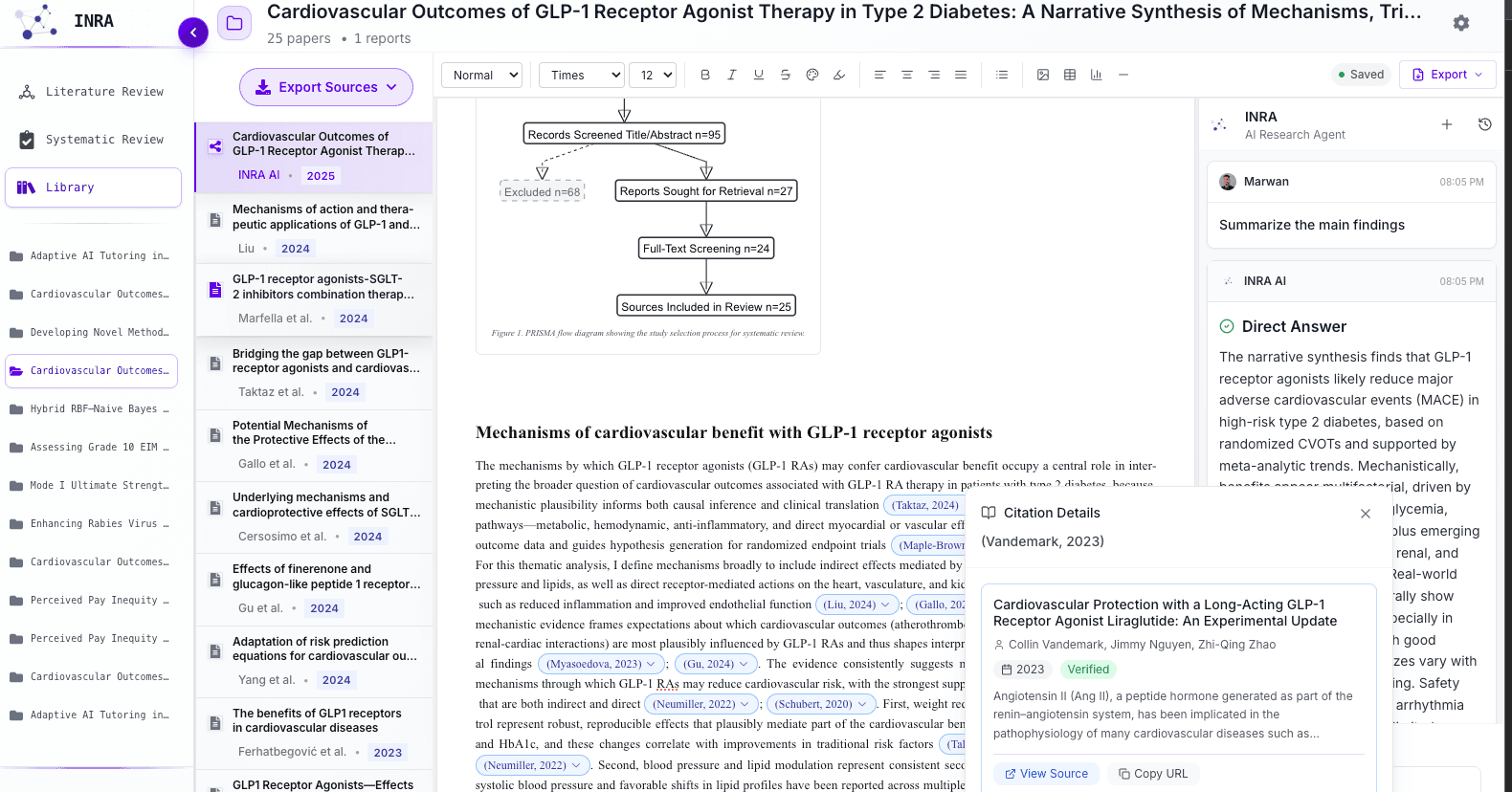
In a narrative review, edit the text and refine the structure in the editor. Export to Word, PDF, or LaTeX to share the draft or continue working.
Open a citation to see its source details and follow the link to the original paper. Supporting passages are shown when available; you decide whether the evidence supports the claim.
Use research chat alongside your narrative review to compare findings, explore disagreements, and decide what needs a closer read.
In SLR Copilot, reviewers screen studies independently, resolve conflicts, and record exclusion reasons. AI suggestions support the work; your team makes the final decisions.
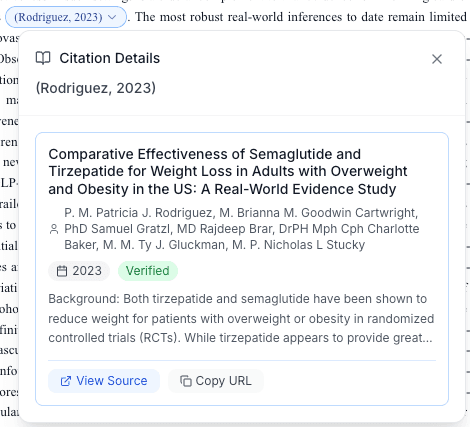
Read the evidence excerpt behind the citation, check the source's title, authors, and year, then open the original paper for a closer read.
Researchers share their experiences with drafting, finding studies, and checking citations in INRA.
“This is a great tool I was surprised how easy it was to use.”
“Writing my dissertation was overwhelming INRA did a good job of helping me organize my thoughts and find relevant studies.”
“The linked citations gave me a ton of confidence in the research and made it so much easier to write my paper.”












Unlimited narrative literature reviews and full access to SLR Copilot. Cancel anytime.
Annual billing works out to six months free.
$10/month, billed yearly
For researchers who need ongoing access.
Cancel anytime.
$7.50/seat/month, billed yearly
Minimum three seats.
Start here if you are comparing the two workflows or checking what the platform can and cannot do.
Choose a Narrative Literature Review when you need a source-linked first draft for topic orientation, a thesis or grant background, or early scoping. INRA retrieves papers, organizes the findings by theme, and gives you a draft to inspect and revise.
Choose SLR Copilot when your team is running a protocol-driven systematic review. It supports citation import, dual screening, full-text review, extraction, risk-of-bias assessment, and exports for PRISMA 2020 reporting. Reviewers make the final decisions.
ChatGPT is a general-purpose assistant. With search or deep research enabled, it can browse the web, work with uploaded files, and produce reports with citations. INRA is built around literature review workflows.
For a narrative review, INRA retrieves academic papers, organizes the evidence, and produces a draft with citations you can open and inspect. SLR Copilot keeps screening, extraction, risk-of-bias work, reviewer conflicts, and review exports in one shared workspace.
ChatGPT can be useful for brainstorming or explanation. Use INRA when you need to keep the evidence, reviewer decisions, and exports together throughout a review. In either tool, check important claims against the original papers.
INRA drafts from papers retrieved for your research session and links citations back to source records you can inspect. Citation checks help flag or remove unresolved references. Supporting passages are shown when available.
This lowers the risk of fabricated references, but it does not guarantee complete coverage or a correct interpretation of every paper. Before using the work in a thesis, manuscript, grant, or policy brief, check important claims, methods, results, and eligibility decisions against the original sources.
Your team sets the review question, criteria, and reviewer rules. You can then import and deduplicate citations, screen titles and abstracts, review full texts, extract study data, assess risk of bias, and export review records.
AI can suggest screening decisions and help with extraction, but reviewers remain responsible for every final decision. Dual screening, conflict resolution, exclusion reasons, and reviewer activity stay on the record.
Narrative reviews currently retrieve records through Semantic Scholar, PubMed Central, and arXiv. INRA may use Unpaywall to locate an open-access copy, and you can add your own PDFs or supported Zotero sources.
SLR Copilot has its own source workflow. It supports citation-file imports, searches through PubMed, OpenAlex, and Semantic Scholar, and DOI or PMID lookup.
No search system includes every paper or full text. Coverage varies by field, publication date, indexing, and access rights. If an important paper is missing, upload the PDF or citation directly.
Yes. The available inputs and exports depend on the workflow.
Yes. Narrative review output supports languages including Arabic, Chinese, French, German, and Spanish. Retrieval remains English-first, so the language of the report and the language coverage of the evidence are not the same thing. Check specialized terminology and translated claims before using the report.
INRA encrypts data in transit and at rest and uses access controls. Research queries and uploaded content may be processed by service providers needed to run the platform's AI features. We do not sell your personal information.
The Professional plan includes unlimited narrative literature reviews and full SLR Copilot access. Monthly and annual billing are available, and you can cancel at any time.
Teams and Institutions adds multi-seat pricing, central billing, and onboarding and support options. Contact us if you need a plan for a lab, department, or university.
Start with a citation-backed narrative review, or open SLR Copilot to run a systematic review with your team, on the record.