INRA logoINRA
Narrative Literature Review

AI literature review generator for source-backed drafts

INRA searches the academic record, organizes evidence into themes, and drafts a narrative literature review with citations you can inspect before using.

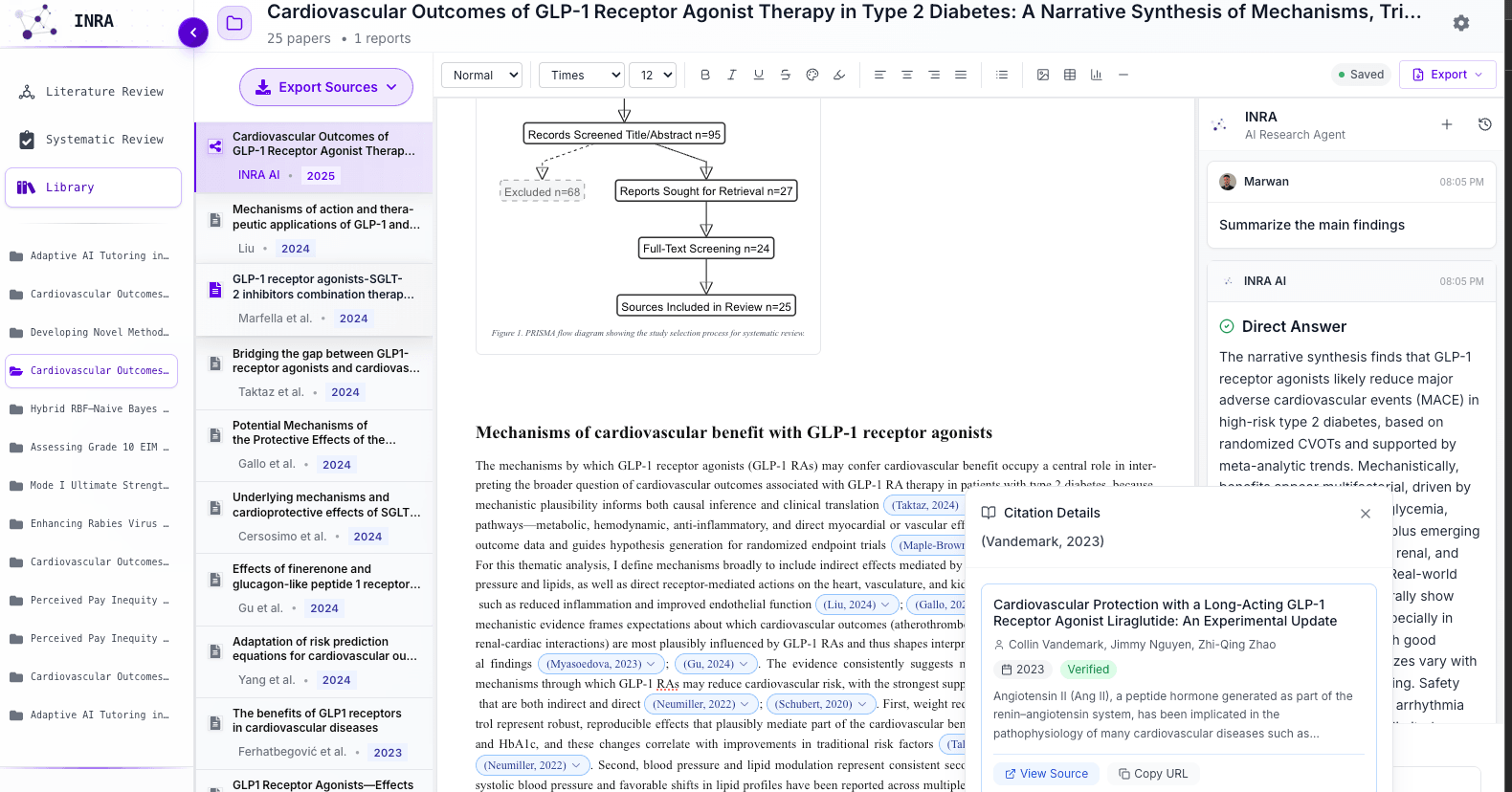
INRA narrative literature review interface with source-backed citations
A generated narrative review draft with inspectable source-backed citations.

What is INRA's AI Literature Review Generator?

INRA's AI Literature Review Generator is a source-backed narrative review tool that searches 220M+ academic papers, supports PDFs and Zotero sources, and drafts literature reviews with inspectable citations.

Who is it for?

It is built for researchers, graduate students, clinical teams, and R&D groups that need a trustworthy literature review draft they can inspect, revise, and cite.

How is it different from a general chatbot?

INRA grounds review drafts in academic sources and keeps claims connected to papers. The workflow is designed for research synthesis instead of open-ended text generation.

Workflow

From research question to inspectable review draft

Search the literature

Start with a research question and search 220M+ papers across academic databases.

Add your sources

Upload PDFs or bring in Zotero sources so known papers and discovered papers are synthesized together.

Organize evidence

INRA groups findings into coherent themes and keeps claims tied to the papers they came from.

Inspect citations

Inline citations link back to source material so researchers can verify evidence before using the draft.

AI Review Tools

INRA vs general-purpose AI writing tools

A narrative literature review needs more than fluent prose. INRA is built around source retrieval, synthesis, citation inspection, and researcher review so drafts can be checked before they become part of a thesis, grant, manuscript, or evidence summary.

Source grounding
General chatbot answers may mix memory, web snippets, and inferred references.
INRA connects claims to academic sources and inspectable citations.
Research inputs
Usually prompt-based unless files are manually added.
Searches 220M+ papers and can incorporate uploaded PDFs and Zotero sources.
Review structure
Requires the researcher to design the synthesis structure.
Organizes findings into themes for a narrative literature review draft.
Verification
Citations can require manual checking outside the tool.
Inline citations are designed to be inspected before the draft is used.

Use Cases

Best for fast synthesis and early research momentum

NLR is the right workflow when you need a trustworthy draft to inspect, revise, and build on. It is especially useful before publication writing, grant planning, and deeper review projects.

Thesis and dissertation literature review chapters
Clinical topic overviews and background sections
Grant proposal evidence summaries
Rapid field orientation before deeper review work
Scoping a topic before launching a systematic review
Synthesizing uploaded PDFs into a structured draft

NLR vs SLR Copilot

Dimension
Narrative Literature Review
Systematic Review Copilot
Best for
Fast synthesis and writing support
Protocol-led systematic review teams
Human control
Researcher edits and verifies the draft
Reviewer decisions drive each phase
Output
Citation-backed narrative report
PRISMA diagram, review data, references
Workflow depth
Search, synthesize, cite, export
Setup, import, screen, full text, extract, RoB, export

FAQ

Narrative review questions

What is an AI literature review generator?

An AI literature review generator helps researchers search, organize, synthesize, and draft a review from academic sources. INRA focuses on source-backed narrative literature reviews, so generated claims are connected to papers that can be inspected.

When should I use a narrative literature review instead of SLR Copilot?

Use a narrative literature review when you need fast field orientation, a thesis or grant background section, or a citation-backed synthesis draft. Use SLR Copilot when your project requires protocol-led screening, reviewer decisions, risk-of-bias assessment, and PRISMA-compliant exports.

Can I use PDFs or Zotero sources?

Yes. INRA supports uploaded PDFs and Zotero sources, so your existing research can be synthesized alongside papers found through academic search.